
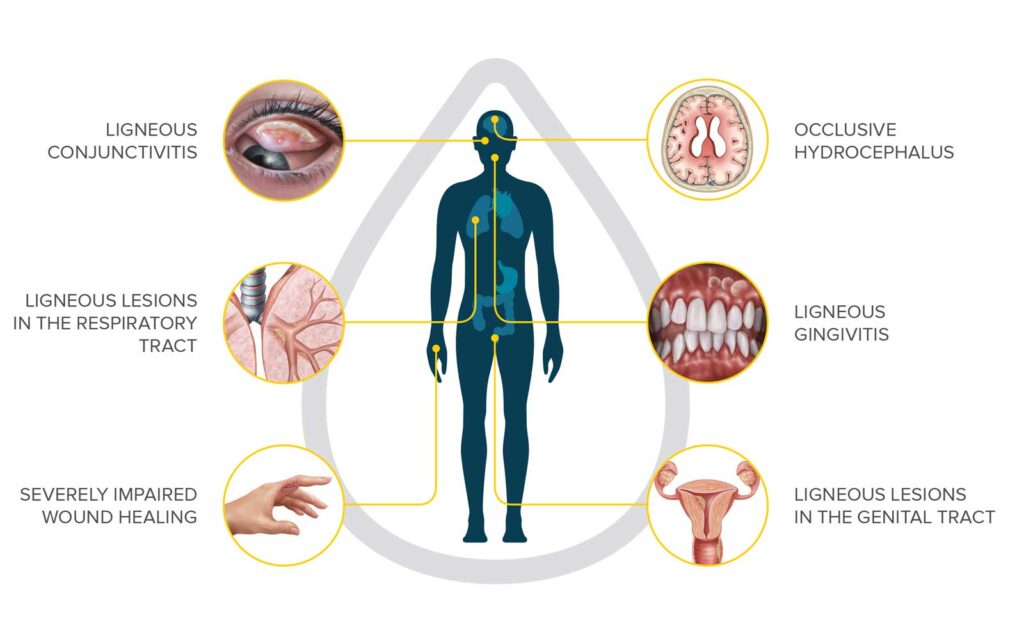
Symptoms of plasminogen deficiency (PLGD) are due to an accumulation of fibrin, a protein involved in the blood clotting system. Individuals with PLGD have too little of the needed normal plasminogen activity to help regulate and dissolve fibrin once formed. Accumulations of fibrin membranes usually occur in areas that have linings called mucous membranes including the eyes, ears, nose, mouth, airways, gastrointestinal and genitourinary tracts, and less commonly, the central nervous system. These abnormal membranes are called “ligneous” because they are “wood-like” in their appearance and can affect the normal function of the involved organ.
The most commonly reported symptoms are lesions in the eyes. Eye lesions, called ligneous conjunctivitis (LC) appear as thick, whitish, hard “woody” growths inside the upper and/or lower eyelids. LC events may result in chronic tearing, photophobia, pain and corneal abrasions with vision loss. Gum lesions, called ligneous periodontitis, may result in loss of gums and eventually teeth (ref 1). Other documented symptoms included: lesions in the airways also called bronchial lesions (ref 2,3) ear complications, kidney complications, and glass-like growths on skin (colloid milium) (ref 1).
PLGD lesions often appear after minor injury or infection (pink eye, ear infection, or tooth eruption, for instance), but may also appear without injury. These lesions often re-grow quickly after they have been removed. The most severe symptoms are often observed in children but may appear at any time in a person’s life. PLGD is a lifelong disorder that appears to affect females in terms of clinical manifestations more than males. Woman with PLGD may experience painful intercourse, abnormal menses, and infertility (ref 4,5).
- Schuster V, Hugle B, Tefs K. Plasminogen deficiency. J Thromb Haemost. 2007;5(12): 2315-2322.
- Schuster V, Seregard S. Ligneous conjunctivitis. Surv Ophthalmol. 2003;48(4):369-388
- Ciftci E, et al. Ligneous conjunctivitis, hydrocephalus, hydrocele, and pulmonary involvement in a child with homozygous type I plasminogen deficiency. Eur J Pediatr. 2003;162(7-8):462-465.
- Pantanowitz L, et al. Ligneous (pseudomembranous) inflammation involving the female genital tract associated with type-1 plasminogen deficiency. Int J Gynecol Pathol. 2004;23 (3):292-295.
- HISTORY, an International Retrospective and Prospective Registry of Patients with Plasminogen Deficiency. Shapiro et. al. Poster Abstract ISTH2020.